
- Managed portfoliosLet us manage your private markets portfolio
- Direct investmentsBrowse available investments
- RetirementAdd private markets to an IRA
- Managed portfoliosLet us manage your private markets portfolio
- Direct investmentsBrowse available investments
- RetirementAdd private markets to an IRA
Investing 101: A comprehensive guide for investing basics



Welcome to Investing 101, a comprehensive guide designed to help you navigate the world of investing. We at Willow Wealth will provide you with the knowledge and tools necessary to make informed decisions and take the first steps towards building a strong and diverse investment portfolio. Let’s get started!
What is investing?
Investing is the process of allocating your money into various assets, such as stocks, bonds, and real estate, with the expectation of earning a return over time. By investing, you are putting your money to work with the goal of growing it, creating wealth, and achieving financial security.
Benefits of investing
Investing offers several benefits, including:
- Wealth accumulation: Investing in assets that generate a return allows you to grow your wealth over time.
- Financial independence: A well-diversified investment portfolio can potentially provide you with passive income, reducing your reliance on a traditional job and allowing you more freedom and flexibility.
- Inflation protection: Investing in assets that appreciate in value can help protect your money from the eroding effects of inflation.
- Retirement planning: By investing regularly and strategically, you can build a nest egg that will help support you during your retirement years.
5 ways to start investing
There are many investment options available, each with its own unique risk and return characteristics. Here are five common types of investments:
Stocks: Also known as equities or shares, stocks represent ownership in a company. As a shareholder, you can benefit from the company’s growth and receive dividends, which are a share of the company’s profits.
Bonds: Bonds are debt instruments issued by corporations, municipalities, or governments. By purchasing a bond, you are essentially lending money to the issuer, who will pay you interest and eventually return your principal investment.
Mutual funds: A mutual fund is a pooled investment vehicle that collects money from multiple investors and invests in a diversified portfolio of stocks, bonds, or other assets. This allows investors to easily access a professionally managed, diversified portfolio with a single investment.
Exchange-traded funds (ETFs): Similar to mutual funds, ETFs are pooled investment vehicles that hold a diversified portfolio of assets. However, ETFs trade like stocks on an exchange, allowing investors to buy and sell shares throughout the trading day.
Private market: This category includes investments that do not fall into the traditional asset classes of stocks, bonds, and cash. Examples include real estate, private equity, private credit, and hedge funds.
Financial goals
Before you start investing, it’s essential to identify your financial goals. These can range from short-term objectives, such as saving for a vacation or a down payment on a house, to long-term goals like retirement planning or funding your child’s education. By defining your financial goals, you can develop a focused investment strategy that aligns with your specific needs and objectives.
Long-term and short-term financial goals
Your financial goals can be classified as either short-term or long-term:
- Short-term financial goals typically have a timeframe of less than five years. Examples include saving for a wedding, a car, or an emergency fund.
- Long-term financial goals have a timeframe of five years or more. These goals often include retirement planning, saving for a child’s education, or building wealth for future generations.
Setting realistic financial expectations
When setting your financial goals, it’s crucial to be realistic about the returns you can expect from your investments. Keep in mind that the stock market has historically provided an average annual return of around 10% before inflation. However, past performance does not guarantee future results, and your actual returns may vary depending on market conditions, your investment choices, and your individual risk tolerance.
Establishing an investment strategy
Once you have identified your financial goals, you can develop an investment strategy that aligns with your objectives and risk tolerance. Your investment strategy should consider factors such as your investment time horizon, initial investment amounts, and desired asset allocation.
Analyzing time horizon & risk tolerance
Your investment time horizon is the length of time you expect to hold your investments before needing to access the funds. Generally, the longer your time horizon, the more risk you can afford to take on, as your investments will have more time to recover from potential market downturns.
Your risk tolerance is your ability and willingness to accept the possibility of losses in exchange for the potential of higher returns. Factors that can influence your risk tolerance include your age, income, financial stability, and investment knowledge.
Determining initial investment amounts
When determining how much to invest, consider your financial goals, risk tolerance, and time horizon. It’s often recommended to start with a small initial investment and gradually increase your contributions as you become more comfortable with the investing process.
Building an investment portfolio with asset allocation strategies
Asset allocation is the process of dividing your investment portfolio among different asset classes, such as stocks, bonds, and cash. A well-diversified portfolio can help minimize risk and maximize returns by spreading your investments across various assets, reducing the impact of any single investment’s poor performance.
Mutual funds and exchange-traded funds
Mutual funds and ETFs are popular choices for new investors seeking to build a diversified portfolio. These investment vehicles allow you to easily access a professionally managed, diversified portfolio of assets with a single investment. Additionally, index funds, a type of mutual fund or ETF that tracks a specific market index, offer lower fees and often outperform actively managed funds.
Individual stocks and bonds
Investing in individual stocks and bonds can be a rewarding, albeit more complex and time-consuming, approach to building your investment portfolio. While individual securities can offer higher potential returns, they also come with higher risks. Diversifying by building a portfolio of many stocks and bonds can help protect against a loss from one particular security.
Private market investing
Investing in individual stocks and bonds can be a rewarding, albeit more complex and time-consuming, approach to building your investment portfolio. While individual securities can offer higher potential returns, they also come with higher risks. Diversifying by building a portfolio of many stocks and bonds can help protect against a loss from one particular security.
Private market alternatives like real estate, private equity, and private credit can deliver differentiated sources of return relative to traditional stock and bond investments. While access was previously limited for individual investors, institutional investors have allocated upwards of 50% of their portfolios to alternatives for decades. Particularly in periods of economic uncertainty, alternatives have historically delivered stronger risk-adjusted returns, helping protect portfolios from a market downturn.
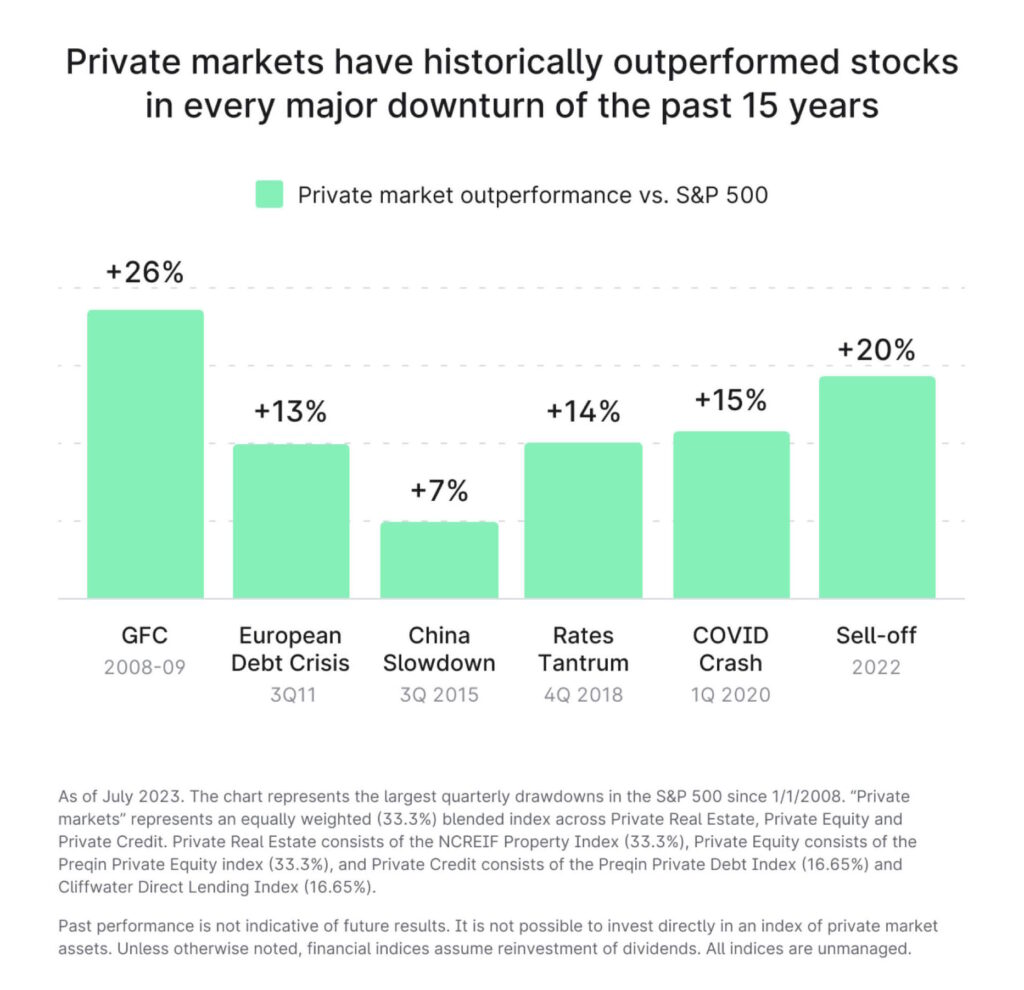
Similar to stocks and bonds, there are multiple ways you can invest in private market alternatives.
Individual investments: Perhaps the most common alternative investment in the U.S. is purchasing a property that generates rental income or is sold after making improvements. You can also work with an asset provider who sources and manages individual investments on your behalf.
Diversified funds: Investors seeking broader exposure to private markets can opt for funds of alternative investments.
These may be specific to one asset class, such as a venture capital fund of startup companies, or multi-asset class.
Conclusion
Becoming an investor is a journey in which you’ll learn how to navigate the world of stocks, bonds, mutual funds, ETFs, and alternative investments. As a new investor, it’s essential to define your financial goals, understand your risk tolerance, and develop an investment strategy that aligns with your objectives. By taking the first investing steps and building a well-diversified portfolio, you’ll be on your way to achieving financial success and securing your future.
What's Willow Wealth?
Willow Wealth enables you to build a private markets portfolio across real estate, private credit, private equity, and more. Our platform provides access to differentiated individual investments and diversified funds, as well as an automated investing solution that handles everything for you. Join more than 500,000 members and start investing today.
Related Content




Products
Company
- About us
- Careers
- Legal documents
Contact us


View Willow 360 Managed Portfolios disclosures
View Willow 360 Managed Portfolios disclosures
Investments made on your behalf in a Willow 360 Managed Portfolio are highly speculative and entail substantial risks, including the fact that such investments are illiquid and subject to significant restrictions on transferability and redemption and that all or a substantial amount of the principal invested may be lost. No amount of diversification can eliminate such risks. Investment strategies such as the ones offered for Managed Portfolios may not be suitable for all investors, and potential investors must make an independent assessment of the appropriateness of any investment in light of their own objectives and circumstances.
Willow Wealth Inc. is the direct owner of Willow Asset Management LLC, which is an SEC-registered investment adviser that manages the Willow Wealth funds and provides investment advice to “retail investors” through “Willow 360 Managed Portfolios.”
Willow Wealth Inc. has an engagement with Atomic Brokerage LLC (“Atomic Brokerage”), a registered broker-dealer and member of FINRA and SIPC, to bring you the opportunity to open a brokerage account. Brokerage services for customers of Willow Wealth Inc.are provided by Atomic Brokerage. Custodial and clearing services are provided to Atomic Brokerage by Pershing LLC. Technology services may be provided by AtomicVest. For more details about Atomic Brokerage, please see the Form CRS, Atomic Brokerage General Disclosures, and the Privacy Policy. Check the background of Atomic Brokerage on FINRA’s BrokerCheck. Fees such as regulatory fees, transaction fees, fund expenses, brokerage commissions and services fees may apply to your brokerage account.
Neither Atomic Brokerage, or Willow Asset Management LLC nor any of their affiliates, is a bank. Investments in securities are Not FDIC insured, Not Bank Guaranteed, and May Lose Value. Investing involves risk, including the possible loss of principal. Before investing, consider your investment objectives and the fees and expenses charged by Atomic Brokerage and Willow Asset Management LLC.
Willow Wealth Inc. is also the indirect owner of Willow Wealth Markets LLC, which is a broker-dealer registered with the SEC and a member of FINRA and SIPC. Despite its affiliation with Willow Asset Management LLC, Willow Wealth Markets LLC does not solicit, sell, recommend, or place interests in any underlying funds in the Managed Portfolios. All trades with respect to underlying funds in the Managed Portfolios will be effected through Atomic Brokerage LLC, an SEC-registered broker-dealer, with Pershing LLC acting as the custodian as appropriate.
View important footnotes related to performance, returns, duration, and other information about Willow Wealth investments
View important footnotes related to performance, returns, duration, and other information about Willow Wealth investments
1 Past performance is no guarantee of future results. Any historical returns, expected returns, or probability projections may not reflect actual future performance. All securities involve risk and may result in significant losses.
3 "Annual interest," "Annualized Return" or "Target Returns" represents a projected annual target rate of interest or annualized target return, and not returns or interest actually obtained by fund investors. “Term" represents the estimated term of the investment; the term of the fund is generally at the discretion of the fund’s manager, and may exceed the estimated term by a significant amount of time. Unless otherwise specified on the fund's offering page, target interest or returns are based on an analysis performed by Willow Wealth of the potential inflows and outflows related to the transactions in which the strategy or fund has engaged and/or is anticipated to engage in over the estimated term of the fund. There is no guarantee that targeted interest or returns will be realized or achieved or that an investment will be successful. Actual performance may deviate from these expectations materially, including due to market or economic factors, portfolio management decisions, modelling error, or other reasons.
4 Reflects the annualized distribution rate that is calculated by taking the most recent quarterly distribution approved by the Fund's Board of Directors and dividing it by prior quarter-end NAV and annualizing it. The Fund’s distribution may exceed its earnings. Therefore, a portion of the Fund’s distribution may be a return of the money you originally invested and represent a return of capital to you for tax purposes.
5 Represents the sum of the interest accrued in the statement period plus the interest paid in the statement period.
6 The internal rate of return ("IRR") represents an average net realized IRR with respect to all matured investments, excluding our Short Term Notes and Structured Notes programs, weighted by the investment size of each individual investment, made by private investment vehicles managed by Willow Asset Management LLCfrom July 1, 2015 through and including March 31, 2025, after deduction of management fees and all other expenses charged to investments.
7 Investors should carefully consider the investment objectives, risks, charges and expenses of the Yieldstreet Alternative Income Fund before investing. The prospectus for the Yieldstreet Alternative Income Fund contains this and other information about the Fund and can be obtained by contacting us or by referring to www.yieldstreetalternativeincomefund.com. The prospectus should be read carefully before investing in the Fund. Investments in the Fund are not bank deposits (and thus not insured by the FDIC or by any other federal governmental agency) and are not guaranteed by Willow Wealth or any other party.
8 You should not construe any information provided here as investment advice or a recommendation, endorsement or solicitation to buy any securities offered on Willow Wealth. The information provided here is of a general nature and does not address the circumstances of any particular individual or entity. You alone assume the sole responsibility of evaluating the merits and risks associated with the use of this information before making any decisions based on such information.
9 Statistics as of the most recent month end.
245 Fifth Avenue 21st Floor, New York, NY 10016
No communication by Willow Wealth Inc. or any of its affiliates (collectively, “Willow Wealth™”), through this website or any other medium, should be construed or is intended to be a recommendation to purchase, sell or hold any security or otherwise to be investment, tax, financial, accounting, legal, regulatory or compliance advice, except for specific investment advice that may be provided by Willow Asset Management LLCpursuant to a written advisory agreement between such entity and the recipient. Nothing on this website is intended as an offer to extend credit, an offer to purchase or sell securities or a solicitation of any securities transaction.
Any financial projections or returns shown on the website are estimated predictions of performance only, are hypothetical, are not based on actual investment results and are not guarantees of future results. Estimated projections do not represent or guarantee the actual results of any transaction, and no representation is made that any transaction will, or is likely to, achieve results or profits similar to those shown. In addition, other financial metrics and calculations shown on the website (including amounts of principal and interest repaid) have not been independently verified or audited and may differ from the actual financial metrics and calculations for any investment, which are contained in the investors’ portfolios. Any investment information contained herein has been secured from sources that Willow Wealth believes are reliable, but we make no representations or warranties as to the accuracy of such information and accept no liability therefore.
Private placement investments are NOT bank deposits (and thus NOT insured by the FDIC or by any other federal governmental agency), are NOT guaranteed by Willow Wealth or any other party, and MAY lose value. Neither the Securities and Exchange Commission nor any federal or state securities commission or regulatory authority has recommended or approved any investment or the accuracy or completeness of any of the information or materials provided by or through the website. Investors must be able to afford the loss of their entire investment.
Investments in private placements are speculative and involve a high degree of risk and those investors who cannot afford to lose their entire investment should not invest. Additionally, investors may receive illiquid and/or restricted securities that may be subject to holding period requirements and/or liquidity concerns. Investments in private placements are highly illiquid and those investors who cannot hold an investment for the long term (at least 5-7 years) should not invest.
Alternative investments should only be part of your overall investment portfolio. Further, the alternative investment portion of your portfolio should include a balanced portfolio of different alternative investments.
Articles or information from third-party media outside of this domain may discussWillow Wealth or relate to information contained herein, but Willow Wealth does not approve and is not responsible for such content. Hyperlinks to third-party sites, or reproduction of third-party articles, do not constitute an approval or endorsement byWillow Wealth of the linked or reproduced content.
Investing in securities (the "Securities") listed on Willow Wealth™ pose risks, including but not limited to credit risk, interest rate risk, and the risk of losing some or all of the money you invest. Before investing you should: (1) conduct your own investigation and analysis; (2) carefully consider the investment and all related charges, expenses, uncertainties and risks, including all uncertainties and risks described in offering materials; and (3) consult with your own investment, tax, financial and legal advisors. Such Securities are only suitable for accredited investors who understand and are willing and able to accept the high risks associated with private investments.
Investing in private placements requires long-term commitments, the ability to afford to lose the entire investment, and low liquidity needs. This website provides preliminary and general information about the Securities and is intended for initial reference purposes only. It does not summarize or compile all the applicable information. This website does not constitute an offer to sell or buy any securities. No offer or sale of any Securities will occur without the delivery of confidential offering materials and related documents. This information contained herein is qualified by and subject to more detailed information in the applicable offering materials.
Willow Wealth Inc. is the direct owner of Willow Asset Management LLC, which is an SEC-registered investment adviser that manages the Willow Wealth funds and provides investment advice to the Willow Wealth funds, and in certain cases, to retail investors.Willow Wealth Markets LLC is an indirect subsidiary of Willow Wealth Inc..Willow Wealth Markets LLC is a broker-dealer registered with the Securities and Exchange Commission (“SEC”) and a member of the Financial Industry Regulatory Authority (“FINRA”) and the Securities Investor Protection Corporation (“SIPC”). Information on all FINRA registered broker-dealers can be found on FINRA’s BrokerCheck. Despite its affiliation with Willow Asset Management LLC, Willow Wealth Markets LLC has no role in the investment advisory services received by Willow Wealth clients.
Willow Wealth is not a bank. Certain services are offered through Plaid, Eisen and Footprint and none of such entities is affiliated with Willow Wealth. By using the services offered by any of these entities you acknowledge and accept their respective disclosures and agreements, as applicable.
Investment advisory services are only provided to clients of Willow Asset Management LLC, an investment advisor registered with the Securities and Exchange Commission, pursuant to a written advisory agreement.
Our site uses a third party service to match browser cookies to your mailing address. We then use another company to send special offers through the mail on our behalf. Our company never receives or stores any of this information and our third parties do not provide or sell this information to any other company or service.
